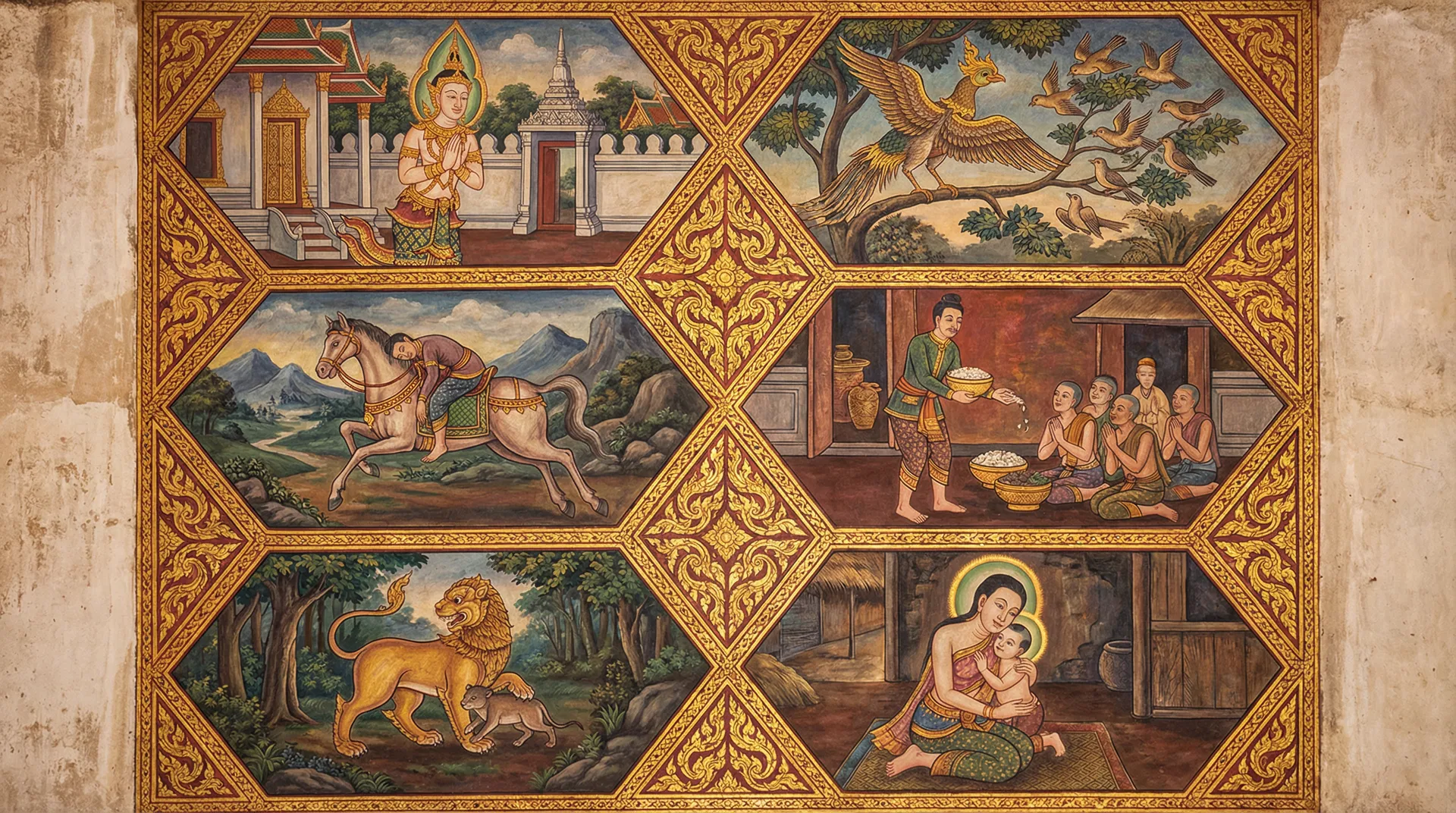
Sutasoma Jātaka
Sutasoma Jātaka
Long ago, in the vibrant city of Indapatta, ruled a king named Piliya, a monarch whose heart was as generous as his kingdom was bountiful. His reign was a golden age, marked by peace, prosperity, and the unwavering devotion of his subjects. Yet, even in such a land of plenty, the whispers of ambition could be heard, particularly from the hearts of those who craved power beyond their station.
In a neighbouring kingdom, known for its warrior spirit and its proud traditions, lived a formidable king named Kamsa. Kamsa was a ruler consumed by a singular, unyielding ambition: to conquer and rule all the lands surrounding his own. His eyes, sharp as a hawk's, were set upon Indapatta, its wealth and its strategic location a tempting prize. He gathered his armies, his banners unfurled like thunderclouds, and marched towards King Piliya's domain.
King Piliya, though a man of peace, was not one to shy away from defending his people. He called upon his loyal warriors, men of courage and skill, to prepare for the inevitable conflict. However, he was also a king who understood the devastating cost of war, the tears shed by widows, and the orphaned children left behind. He sought a path that would avoid bloodshed, a solution that would satisfy Kamsa's ambition without plunging his kingdom into ruin.
It was then that the Bodhisatta, in his past life, was born as Prince Sutasoma, the virtuous and valiant son of King Piliya. Prince Sutasoma was renowned not only for his princely bearing and his martial prowess but also for his profound compassion and his unwavering commitment to non-violence. He possessed a keen intellect and a deep understanding of human nature, seeing the underlying desires and fears that drove even the most aggressive of men.
As Kamsa's army approached the borders of Indapatta, Prince Sutasoma, with a heavy heart but a resolute spirit, made a bold proposal to his father. "Father," he said, his voice calm and steady, "I have a plan to avert this war. King Kamsa seeks glory and dominance. Let me face him, not on the battlefield, but through a contest of strength and courage. I will offer myself as a prize, a testament to my kingdom's valor. If I am defeated, Kamsa may claim me, and with me, perhaps, a measure of his desire for conquest. But if I prevail, his ambition will be tempered, and peace will be restored."
King Piliya, torn between paternal love and the well-being of his kingdom, was deeply troubled. "My son," he implored, "this is a perilous path. Kamsa is a ruthless warrior. I cannot bear the thought of you facing such a danger."
Prince Sutasoma, however, remained steadfast. "Father," he replied, "true courage lies not in avoiding danger, but in facing it with wisdom and compassion. I believe that through this trial, we can achieve a lasting peace, free from the ravages of war. I am willing to lay down my life if it means saving thousands of others."
Understanding his son's unwavering conviction and his noble intentions, King Piliya, with a heavy heart, granted his consent. News of Prince Sutasoma's offer reached King Kamsa, who, intrigued by the audacity of the proposal, readily agreed. He saw it as an opportunity to humiliate King Piliya and seize a valuable prize without the costly effort of a full-scale invasion.
The contest was arranged. Prince Sutasoma, adorned in simple, unadorned armor, met King Kamsa on a vast plain between the two kingdoms. The air was thick with anticipation, the armies of both sides watching in silent awe. Kamsa, a hulking figure of brute strength, sneered at the prince. "You dare to offer yourself as a pawn in my game, young prince? Your father must be desperate indeed."
Prince Sutasoma, with a gentle smile, replied, "King Kamsa, I offer not myself as a pawn, but as an embodiment of my kingdom's spirit. Let our contest decide the fate of our peoples, not through bloodshed, but through a demonstration of strength and resolve."
The combat began. Kamsa fought with a ferocity born of aggression, his blows powerful and relentless. Prince Sutasoma, however, moved with an almost divine grace. He met each of Kamsa's attacks not with brute force, but with skillful deflection and precise counter-strikes. He used Kamsa's own strength against him, evading his charges and redirecting his momentum. It was a dance of power and precision, a testament to the prince's superior training and his calm demeanor.
As the battle raged, Prince Sutasoma saw an opening. With a swift, decisive movement, he disarmed Kamsa, his sword clattering uselessly to the ground. Kamsa, stunned and humiliated, stood defenseless before the prince. The crowd gasped, expecting the prince to strike the final blow, to end the contest with Kamsa's life.
But Prince Sutasoma did not raise his sword in anger. Instead, he lowered it, his gaze filled with compassion. "King Kamsa," he said, his voice resonating with a newfound authority, "you have fought bravely, but your heart is consumed by pride and a lust for power. Today, you have seen that true strength lies not in conquest, but in restraint and wisdom. I could end your life now, but that would only sow seeds of further hatred and conflict. Instead, I offer you a choice: return to your kingdom, abandon your ambitions of conquest, and live in peace. Or, if you persist in your destructive path, you will face the consequences of your own actions."
Kamsa, humbled by the prince's mercy and awed by his skill, was deeply moved. He saw the futility of his quest for dominance and the wisdom in Sutasoma's words. He bowed his head, his arrogance replaced by a profound respect. "Prince Sutasoma," he said, his voice rough with emotion, "you have shown me a greater strength than I have ever known. Your mercy is more potent than any weapon. I have been a fool, blinded by ambition. I pledge to you, and to your father, that I will trouble your kingdoms no more. I will return to my land and rule with a newfound understanding."
And so, a great war was averted. Prince Sutasoma, the Bodhisatta, had not only saved his kingdom from destruction but had also transformed the heart of a conqueror. King Kamsa, true to his word, returned to his kingdom and became a just ruler, his days of aggression replaced by a commitment to peace. The story of Prince Sutasoma and his compassionate victory spread far and wide, becoming a legendary tale of how wisdom, courage, and mercy can triumph over brute force and destructive ambition.
The people of Indapatta rejoiced, their hearts filled with gratitude for their valiant prince. King Piliya, his eyes shining with pride and relief, embraced his son, knowing that the future of his kingdom was secure in the hands of such a virtuous leader. The Sutasoma Jātaka stands as an enduring testament to the fact that true victory is not found in vanquishing an enemy, but in transforming them, and that the greatest strength lies in the power of compassion and understanding.
— In-Article Ad —
💡Moral of the Story
True victory is achieved not through violence and conquest, but through wisdom, compassion, and the ability to show mercy.
Perfection: Compassion (Karuna)
— Ad Space (728x90) —
More Jataka Tales You May Enjoy
 429Navakanipāta
Asadisa Jataka
The Tale of the Unrivaled Gift In the magnificent city of Savatthi, there lived a king named Suppara...
💡 True generosity is selfless and unconditional. It is given without expectation of reward, without seeking praise, and without any thought of the giver's own comfort. Such giving nourishes both the recipient and the giver, bringing peace and contentment.
 404Sattakanipāta
Sama Jataka
Sama JatakaIn the tranquil foothills of the Himalayas, where the air was crisp and the scent of pine...
💡 Filial piety (devotion to parents) and a life lived with unwavering virtue and sincerity possess immense power, capable of overcoming even the gravest of misfortunes.
 307Catukkanipāta
Sūci-Jātaka
The Needle's TaleIn the vibrant city of Kosambi, lived a king named Bhimasena. He was known for his ...
💡 True value is found not in the material itself, but in the skill, patience, and mindfulness with which it is used. Every action should be purposeful, flowing seamlessly into the next, minimizing waste and maximizing the impact of our efforts.
 178Dukanipāta
Mūgapakkha Jātaka
Mūgapakkha JātakaIn the bustling city of Varanasi, renowned for its vibrant arts and thriving commer...
💡 True wisdom is not always expressed through eloquent words. Deep observation, keen discernment, and insightful actions can reveal truths that speech may conceal. Silence can be a powerful medium for conveying profound understanding.
 3Ekanipāta
The Bodhisattva and the Golden Deer
The Bodhisattva and the Golden Deer In the ancient kingdom of Mithila, nestled amidst emerald fores...
💡 Selfishness and the failure to help others lead to suffering. When we help others, we receive good in return.
329CatukkanipātaThe King of the Elephants Jataka
The King of the Elephants Jataka In the heart of a dense, primeval forest, where the trees soared to...
💡 True leadership demands courage, perseverance, and selfless dedication to ensure the survival and well-being of the community, even in the face of extreme adversity.
— Multiplex Ad —